Reviews of Spacecraft 100 Iconic Rockets Shuttles and Spacecraft That Put Us in Space
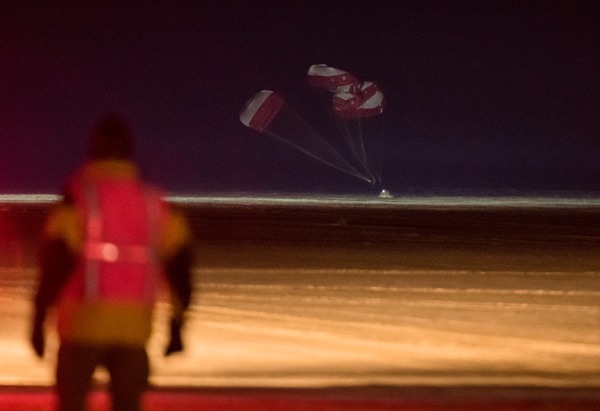 A fellow member of Boeing's recovery team watches as the CST-100 Starliner spacecraft lands at White Sands, New United mexican states, December 22. (credit: NASA/Aubrey Gemignani) The year of commercial coiffure comes to an end, without coiffure Remember when 2019 was going to be the year of commercial crew? NASA and the space community certainly entered the year with high hopes that this would, at concluding, exist the year that American astronauts, launching on American rockets from American soil (to use a common refrain of NASA ambassador Jim Bridenstine), would reach orbit for the kickoff time since the stop of the shuttle program. Both Boeing and SpaceX appeared to be getting close to the test flights of their commercial coiffure vehicles, optimism buoyed by SpaceX's successful Demo-i mission, an uncrewed test flight of its Crew Dragon spacecraft in March (meet "The beginning of the end of commercial coiffure evolution", The Infinite Review, March 11, 2019). "By early next year, nosotros're going to exist launching American astronauts on American rockets from American soil again," Bridenstine said the mean solar day before launch. Getting across the finish line, though, was harder than NASA or either visitor expected. SpaceX suffered a setback in Apr when the same Crew Dragon spacecraft that flew Demo-1 was destroyed during preparations for a static-fire test of its SuperDraco arrest thrusters ahead of an in-flight abort exam. SpaceX and NASA spent months on the investigation, while SpaceX had to use the spacecraft intended for the Demo-ii crewed exam flight for that in-flight abort test, which is now scheduled for no earlier than January 11. If that exam if successful, Demo-2 will likely follow, using a new Crew Dragon spacecraft, later in the year, awaiting work such every bit testing of the spacecraft's parachutes (another challenge for the visitor this year.) Boeing, at the time of Demo-1, had planned to fly an uncrewed test flight of its CST-100 Starliner spacecraft some time in the jump. All the same, that Orbital Flying Examination (OFT) mission was delayed by months. In the interim, the company carried out a pad abort exam of Starliner, using its launch almost thrusters to leap off a pad at White Sands Missile Range in New Mexico in November. But that was non without incident, either: one of 3 main parachutes failed to open, which the visitor said was caused when a pin wasn't properly inserted in the parachute rigging. Boeing, though, pressed alee with the OFT mission, with a launch date that finally stabilized at December 20. Information technology was an opportunity for the commercial crew program to end the twelvemonth on something of a high note: while it didn't get people into orbit this year, it did put both spacecraft through successful test flights that will permit crewed examination flights to have identify in the "first part" of 2020, as Bridenstine and other NASA officials frequently said. Boeing and NASA were optimistic in the days leading up to the Ofttimes mission. The spacecraft cleared a serial of reviews without any issues, and its rocket, a United Launch Alliance Atlas V, was ready. This would be the first flight of a new variant of the rocket, formally known every bit an Atlas V N22: for the offset fourth dimension the rocket would launch without a payload fairing (the N in its designation) and with a dual-engine Centaur upper stage (the 2d 2 in that designation.) The dual-engine Centaur, which had flown on earlier Atlas rockets, was needed because of the mission'south unusual contour. "The main reason for using the dual-engine Centaur is to flatten out the trajectory such that we can enable condom aborts if that should exist necessary," said John Elbon, main operating officer of ULA. That reduces the g-forces should an abort and reentry be required, and likewise avoids a "blackout zone" in the north Atlantic. If all went as planned, the Centaur would release the Starliner into a suborbital trajectory about fifteen minutes later liftoff from Cape Canaveral, with the spacecraft using its thrusters to maneuver into orbit nearly 15 minutes after that. That would keep Starliner from being stranded in orbit if the thrusters didn't work for some reason—but would play a dissimilar role in what happened on OFT. 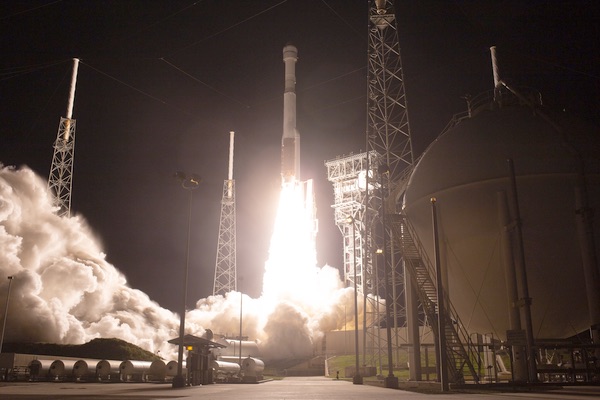 The ULA Atlas V conveying Starliner lifts off from Florida December 20. (credit: NASA/Joel Kowsky) The mean solar day before the launch, NASA was already looking ahead beyond OFT. "This examination flight tomorrow past the Boeing Starliner is the adjacent step in this mighty vision," Bridenstine said during a printing conference by the countdown clock at the Kennedy Infinite Center, flanked by the astronauts would fly on both Starliner'due south crewed flight test and its first operational mission. "Past early on next year, we're going to exist launching American astronauts on American rockets from American soil over again." "Our spacecraft needs to attain downwardly into the Atlas 5 and figure out what fourth dimension it is," said Chilton. "We reached in and grabbed the wrong coefficient." In the hours leading up to liftoff there were no issues reported with either Starliner or the Atlas, with the only worry being strong winds at ground level that ultimately didn't pose a adventure to the launch. At half-dozen:36 am EST, the Atlas lifted off from Infinite Launch Circuitous 41, soon putting on a light show for much of the southeastern US equally its contrail became backlit by the Sun in the early morning skies. The Atlas did its chore. "We achieve those separation parameters and, in fact, literally hit a bullseye," at the time of spacecraft separation, ULA president and CEO Tory Bruno said at a mail-launch press conference at KSC. Attention turned to the Johnson Space Center, which Boeing uses equally mission control for Starliner, for that thruster burn to put the spacecraft into orbit. Viewers waited, and waited, and waited some more for an update on the status of the Starliner. Finally, NASA Goggle box commentators appear that there was an "off-nominal" orbital insertion. That led to confusion near whether the spacecraft was, in fact, in orbit—recall information technology was released into a suborbital trajectory as planned—until those commentators said the spacecraft was in a "stable" orbit, but patently not the i planned. A couple hours afterward, reporters packed the modest "auditorium" at the press site—more like a big classroom, right down to the chairs with small desks built into them—for an update. "It appears equally though the mission elapsed timing system had an error, and that bibelot resulted in the vehicle assertive that the fourth dimension was different than it actually was," Jim Bridenstine said at the conference. The details about what happened took shape at that briefing as well as two that followed on Saturday and Sunday. The spacecraft has a timer that tracks the fourth dimension elapsed on the mission, and uses that to determine what the spacecraft should be doing at that stage of flight. That timer is initialized by communicating with the Atlas rocket prior to liftoff. "Our spacecraft needs to reach down into the Atlas 5 and figure out what time it is," said Jim Chilton, senior vice president for Boeing's space and launch partitioning, at Saturday's briefing. "We reached in and grabbed the wrong coefficient." A 24-hour interval later, he said that resulted in the timer being off by xi hours. Why the spacecraft "grabbed the incorrect coefficient" isn't clear. "If I knew, it wouldn't take happened," Chilton said, citing "extensive testing" washed prior to launch. "We are surprised. A very large body of integrated tests, approved by NASA, didn't surface this." That miscalibrated timer, Boeing and NASA said, caused the Starliner to retrieve it was in a different phase of the mission presently after spacecraft separation, and started firing its mental attitude control thrusters. That used up much more than fuel than planned for that phase of the mission, and efforts by spacecraft controllers to recover information technology were exacerbated by a communications problem. (Boeing originally said Starliner was caught in a gap between two NASA TDRS communications satellites, but later best-selling it was more than likely the spacecraft was in the wrong orientation to communicate with them.) While controllers afterwards stabilized the spacecraft, that anomaly ruled out a scheduled docking with the ISS a day later on launch. "We but didn't take enough fuel" to become to the ISS, even after correcting the timer issue, Steve Stich, deputy manager of NASA's commercial crew program, said Saturday. "We didn't take enough propellant to go upwardly close to station, even to approach." With an ISS docking ruled out, NASA and Boeing decided to instead carry a truncated ii-day mission, performing equally many other tests as it could in the express time and without access to the ISS. The joint Boeing and NASA team has done a good chore at looking at things we tin can practice to get ahead and buy back some mission objectives," Stich said. For example, while Starliner couldn't dock with the ISS, it could test communications with the station and also extend and retract its docking adapter. "To me, there'due south good data out there that suggests that, once we get through information technology, peradventure it'due south acceptable to become, as the side by side footstep, the Crew Flight Exam," said Stich. The big milestone, though, was to demonstrate that Starliner could safely return to Globe. At seven:23 am EST Sunday, the spacecraft fired its thrusters for a deorbit burn, descending towards White Sands, New United mexican states. As ground crews, and a NASA aircraft equipped with infrared cameras, waited and watched, Starliner reentered. This fourth dimension, Starliner performed exactly every bit expected, deploying all its parachutes—including all three main ones—and touching down right on target at vii:58 am at White Sands Space Harbor, the landing site of the STS-three shuttle mission in 1982. Despite the early difficulties, NASA and Boeing emphasized the accomplishments of the overall mission. "A lot of things went right," Bridenstine said at a post-landing briefing Dominicus. With the successful landing, "a whole lot more things did become correct, went very, very well." "Today, it couldn't really have gone any meliorate," Chilton said of the landing. 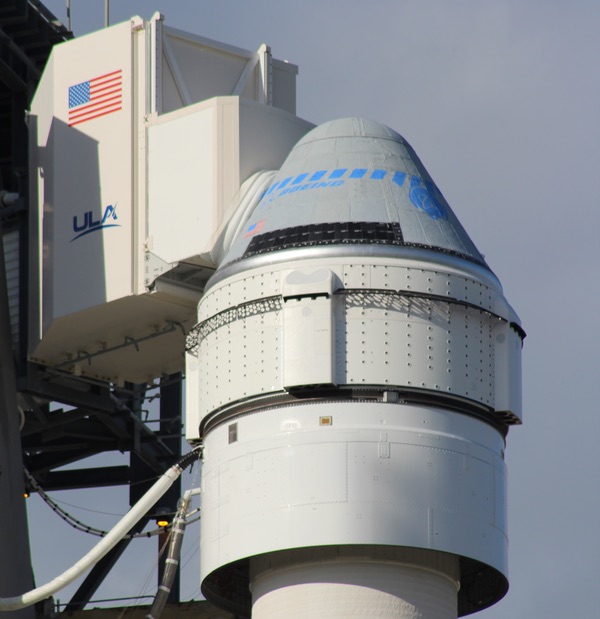 Starliner on acme of its Atlas V rocket the day before launch. (credit: J. Foust) What'south unclear, though, is what comes next. Without docking at the ISS Starliner didn't achieve all its mission objectives. Chilton estimated that, based on the data currently available, the spacecraft achieved "depression 60 percentage" of those objectives. Once post-landing analysis of the data collected during the mission is consummate, he said that could rise to 85 to xc pct. Is that enough to allow Boeing to proceed with its Crew Flight Test mission, with NASA astronauts Mike Fincke and Nicole Mann, and Boeing astronaut Chris Ferguson, on board? NASA officials hinted subsequently landing that this could happen. "We have a solid understanding of the challenge that nosotros had, and why it occurred," Bridenstine said. "It is not something that is going to prevent us from moving forward chop-chop. We tin still move forwards quickly. Nosotros tin get it fixed." "We demand to take a picayune bit of time to look through all the data and encounter how the vehicle performed in all phases," Stich said. "To me, there's adept data out there that suggests that, one time we get through it, maybe it's acceptable to become, equally the side by side step, the Crew Flight Examination." One trouble is that, based on Boeing's original Commercial Coiffure Transportation Capability (CCtCap) contract, it didn't achieve all of its requirements. "The Contractor'south flying test program shall include an uncrewed orbital flying test to the ISS," that contract states. "The OFT shall include a CCTS [commercial crew transportation arrangement] that validates terminate-to-cease connectivity, LV [launch vehicle] and CST-100 integration, launch and flying operations, automated rendezvous and proximity operations, and docking with the ISS, bold ISS blessing." "In that location's as well a deviation between what is a NASA requirement and what is a contractual requirement for this item flight test," Bridenstine said when asked nigh the contract language. "The NASA requirement might non be the same as the contractual requirement for this particular flying examination." There is a certain logic with proceeding with a crewed flight even without docking with the ISS. Starliner has demonstrated it tin both launch and land safely, two of the near disquisitional aspects of flying. (Bridenstine often noted in the days subsequently launch that not all mission requirements are created equal, with more than emphasis on launch and landing.) If a crewed test flight wasn't able, for some reason, to dock with the station, information technology could at to the lowest degree get the crew back dwelling house safely. "Boeing has had a very dissimilar chore from what SpaceX had," Bridenstine said. "The cost to modify from commercial [cargo] resupply to commercial crew was not every bit much every bit what Boeing did, basically starting from scratch and trying to come across the same timeline for commercial homo spaceflight." However, whatever changes to Boeing's plans are likely to face additional scrutiny given the other problems the visitor is facing, in detail the extended grounding of its 737 MAX airliners later on two fatal crashes. While there's no obvious technical link between the problems with the airliners and Starliner's software, public perception—as well every bit political perception on Capitol Hill and elsewhere—is a different matter. (As this commodity was being prepared for publication on the forenoon of December 23, Boeing announced its CEO, Dennis Muilenburg, had resigned, constructive immediately.) Even before this exam flight, Boeing had been on the defensive after a report by NASA's Part of Inspector General final month criticized the company and NASA for contract changes that gave the company nearly $300 million in additional funding to advance production of future Starliner spacecraft, of which well-nigh two-thirds the inspector general deemed was unnecessary. That report also noted that Boeing's per-seat price of $ninety million was far higher than SpaceX's $55 meg, or even the roughly $85 million NASA has been paying Roscosmos for Soyuz seats. The report fifty-fifty stated that unnamed NASA officials believed that, without that additional funding, Boeing might drop out of the commercial coiffure program altogether. Boeing criticized some of the claims of that report, including the merits it would drib out of the plan. At that pre-launch printing conference Bridenstine came to the company's defence, including criticism that Boeing's CCtCap contract, with an original value of $4.2 billion, was far higher than SpaceX's $2.6 billion. "Boeing has had a very different job from what SpaceX had," Bridenstine said, because SpaceX could modify its existing cargo Dragon spacecraft. "The price to change from commercial [cargo] resupply to commercial crew was not every bit much as what Boeing did, basically starting from scratch and trying to meet the aforementioned timeline for commercial human spaceflight." "I've seen a lot of reporting on what the toll per seat volition be. I volition likewise tell y'all, NASA has not negotiated what the price per seat will be, then I don't know where a lot of these numbers are coming from," he added. Those per-seat costs, of course, came from the agency'south ain inspector full general. And then 2019 comes to an end without American astronauts launching on American rockets from American soil, simply equally 2018 did, and 2017, and and so on. There is all the same optimism that 2020 volition finally be that year, particularly with uncrewed test flights, of varying degrees of success, at present in the books. Just NASA is in discussions with Roscosmos about buying 2 additional Soyuz seats for missions in the fall of 2020 and the jump of 2021, only in case. Notation: we are temporarily moderating all comments submitted to deal with a surge in spam. Abode | |
Source: https://www.thespacereview.com/article/3856/1
0 Response to "Reviews of Spacecraft 100 Iconic Rockets Shuttles and Spacecraft That Put Us in Space"
Post a Comment